


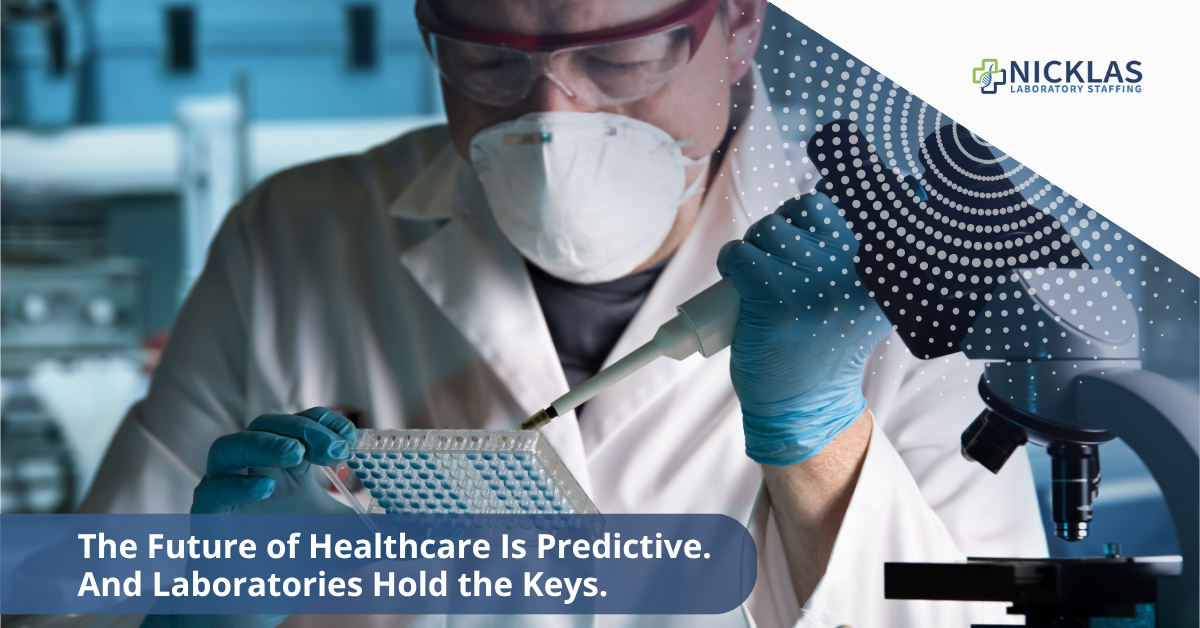
Netflix knows what you’ll watch next. Amazon knows what you’ll buy next. In healthcare, prediction is no longer science fiction -it’s the next frontier. But predictive medicine doesn’t begin with aggregated claims data or wearables. It begins with something far more fundamental: your blood, tissue, and molecular profile.
And where does that raw signal come from? The clinical laboratory.
Predictive Medicine Starts in the Lab
Healthcare is undergoing a fundamental shift from treating illness once it appears to anticipating risk and preventing it before it happens. Predictive analytics, precision medicine, and preventive care are shaping how hospitals design treatment pathways, manage chronic disease, and allocate resources.
But all predictive models, no matter how sophisticated, require one thing: reliable inputs. Clinical labs provide the foundational data.
- Lab-derived biomarkers are the building blocks of predictive models, offering insight into everything from cardiovascular risk to cancer susceptibility.
- AI-integrated lab data enables more accurate forecasting by feeding validated results into machine learning models.
- Even routine hematology panels have predictive value. Recent research shows standard lab data can help forecast disease risk and outcomes.
From the most advanced genomic assay to the most basic blood count, the laboratory supplies the evidence that makes predictive healthcare possible.
The Engine Behind Predictive Healthcare
Predictive care may sound futuristic, but its foundation is already in place. Every hospital lab today is generating structured, validated datasets that can plug directly into predictive engines. The difference between hospitals that lead and hospitals that lag will come down to how well they integrate and expand their laboratory capacity.
The lab’s role goes beyond testing—it becomes the bridge between raw biology and actionable forecasting. That bridge is built on:
- Accuracy: Predictive models are only as strong as the data that feeds them. High-quality, reproducible lab results ensure clinical trust.
- Volume: The scale of lab testing provides massive datasets across populations, fuel for population health initiatives.
- Innovation: Tools like molecular diagnostics, biomarker panels, and genomics open new possibilities for predictive modeling.
The laboratory doesn’t just support predictive care; it makes it possible.
Why This Matters for Labs and Professionals
The rise of predictive medicine carries important implications not just for hospitals but for the professionals working in laboratories. Demand for lab capacity is expected to grow sharply as predictive analytics becomes standard in care delivery.
That growth comes with challenges:
- Workforce shortages already impact labs nationwide, and the predictive healthcare revolution will only widen the gap.
- New skill sets are increasingly valuable. Professionals with expertise in assay interpretation, laboratory informatics, and data analysis will be positioned as leaders in this new era.
- Cross-disciplinary collaboration will become the norm. Labs won’t operate in silos, they’ll partner with data scientists, clinicians, and hospital administrators to shape predictive pathways.
For laboratorians, this is both a challenge and an opportunity. Those who invest in skills beyond the bench will be at the forefront of the predictive healthcare movement.
From Present Function to Future Vision
Hospitals that view the lab purely as a diagnostic service risk falling behind. The laboratory is the gateway to predictive and personalized medicine. By building up lab infrastructure, investing in informatics, and supporting the professionals who interpret the data, hospitals can position themselves to thrive in an era defined by anticipation rather than reaction.
The shift is already underway. The question for hospital leaders? Whether their organizations will be ready to meet it.
Where Tomorrow’s Care Begins
Medicine is moving toward predictive and personalized care, and that vision begins in the lab. The results generated today don’t just inform current treatment, they shape models that define tomorrow’s care.
By expanding laboratory capacity and supporting the professionals who power them, healthcare leaders can ensure their organizations aren’t just participating in the future of medicine –they’re driving it.
Is your hospital ready to build the lab workforce that powers predictive healthcare?