


The AI “Infrastructure Tax”: Why Digital Pathology Will Require More Staff, Not Less
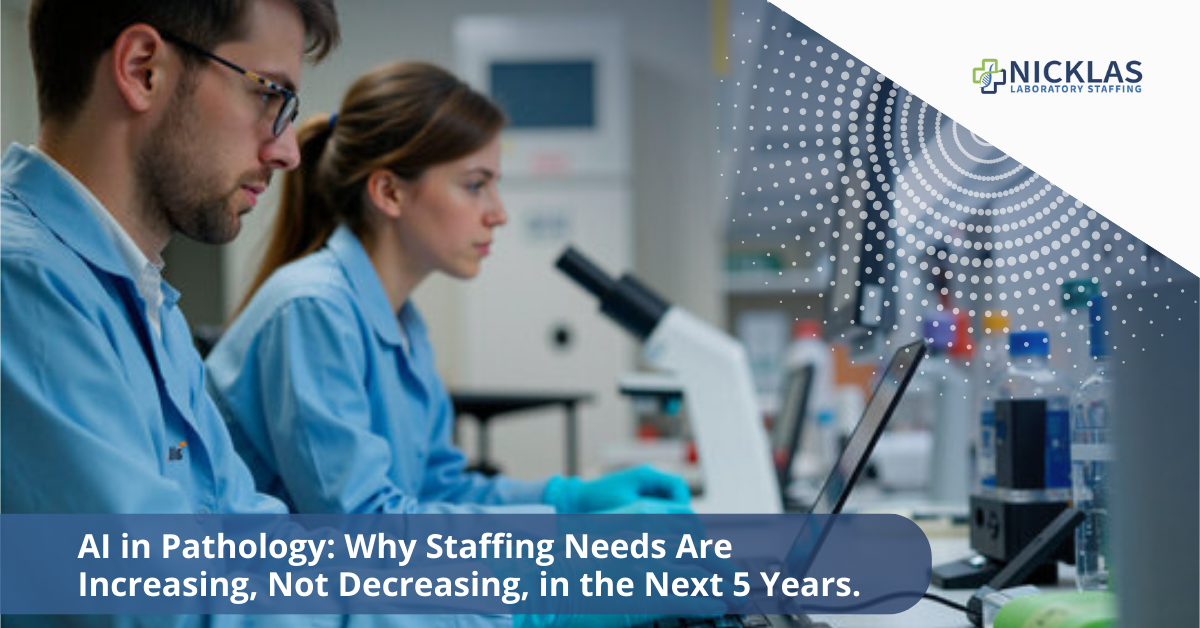
The narrative that Artificial Intelligence (AI) will replace pathologists has dominated headlines for a decade. Yet, for lab directors facing real-world implementation, the reality is the opposite: AI creates an Infrastructure Tax. Far from reducing headcount, AI in pathology and emerging digital pathology trends are creating new, mandatory roles that must be filled for successful, compliant implementation.
The AI “Replacement Myth” vs. The Digital Reality
The fear that automation eliminates jobs is a natural anxiety. But in clinical pathology, a field defined by complexity and regulation, AI doesn’t eliminate the human; it shifts the human from the microscope to the monitor and creates new layers of necessary labor in three critical areas: Digitization, Validation, and Data Stewardship.
If your lab is moving toward digital pathology and AI, your staffing budget must account for this increased complexity, or your expensive new systems will sit idle. This shift is one of the clearest indicators of how the future of pathology jobs is evolving, not shrinking, but diversifying.
The “Scanning Tax”: New Staff for Digitization & QA
The first, immediate increase in staffing comes not from the AI itself, but from the process required to feed it: Whole Slide Imaging (WSI). This is where digital pathology staffing begins to expand.
An AI model is useless if it doesn’t have perfectly prepared, high-quality digital images. Converting glass slides to digital files is a rigorous, high-volume manufacturing process that cannot be reliably performed by pathologists or existing histotechnologists without significant workflow disruption.
- The Data Point: Industry benchmarks suggest that successful digital labs need a dedicated staff ratio of 0.3 to 1.0 Full-Time Equivalent (FTE) Scanning Technician per scanner to handle loading, quality assurance (QA), and troubleshooting (Digital Pathology Association).
- The Role: These are not just “button-pushers.” They are Histotechs with specialized IT skills. They need to catch focus errors, barcode misreads, and tissue folds before the AI sees them, ensuring every image meets clinical standards. This requires specialized training in optics, software, and tissue preparation quality control (QC).
The Validation Burden: The Hidden Workload of “Human-in-the-Loop”
If the scanning process is the Infrastructure Tax, validation is the Regulatory Compliance Burden—and it requires significant, dedicated pathologist and technician time.
AI algorithms are not “set-it-and-forget-it” software. They must be validated to clinical standards before being used for patient care, and they must be continuously monitored for “drift.” These are some of the most commonly underestimated AI implementation challenges in labs today.
- The Regulatory Cost: A lab must validate an algorithm against a minimum of 60 cases for each specific application (e.g., Prostate Gleason, Breast HER2) (CAP Guidelines). This means hundreds of hours dedicated solely to double-reading cases (glass vs. AI) to prove concordance.
- The Time Cost in Detail: This process requires a Pathologist (your most expensive resource) to perform non-billable, comparative reading. This mandates a Pathologist FTE dedicated to Informatics and Validation whose schedule is specifically carved out for this non-clinical work.
The Rise of the Computational Pathology Scientist and Informatician
As your lab’s digital data repository grows (often into petabytes of storage), you face a third staffing challenge that is purely technical and scientific: managing the AI environment itself.
This requires the emergence of a new class of hybrid professional: the Pathology Informatician or Computational Pathology Scientist, a role increasingly highlighted in discussions about pathology informatics jobs.
Why You Need Them
This role is the essential bridge between the clinical lab (AP/CP), IT, and the AI vendor. The need for this specialized talent has been highlighted in publications by the Association for Pathology Informatics. They are needed for:
- Data Governance: Managing Petabytes of image data (a single large lab can easily hit 5-10 Petabytes of storage).
- Interoperability: Ensuring the WSI scanner talks flawlessly to the Laboratory Information System (LIS) and the AI software.
These candidates are rare and command high salaries, often being poached by large pharmaceutical or technology firms.
The Strategic Shift: From Saving Money to Scaling Capacity
The initial investment in AI creates a more complex staff ecosystem, not a simpler one. If hospital administration views AI only as a cost-cutting measure for existing headcount, the implementation will fail.
AI in pathology is, fundamentally, an investment in scalability, quality, and fighting pathologist burnout. It frees existing staff from repetitive tasks so they can focus on complex diagnostics and clinical interpretation, but only if the new infrastructure roles are filled. Pathologist burnout rates, reported as high as 80% in some recent studies, confirm the critical need to offload non-diagnostic tasks.
The Nicklas Solution:
Don’t let your digital transformation stall because you lack the specialized human infrastructure. Nicklas Staffing understands the difference between a traditional Histotech and a Digital Pathology Coordinator, and we know where to find the rare Computational Pathology Scientists needed to make your AI investment work.
Contact us today to audit your AI readiness and secure the talent that will drive your lab’s future.