


Introduction: The Heart of the Diagnosis in 2026
Today, March 10, 2026, we celebrate Histotechnology Professionals Day. In the modern, technology-driven laboratory, the role of the histotechnologist has undergone a profound professional elevation. Today we recognize these essential providers by their updated and well-earned title: Scientist in Histology.
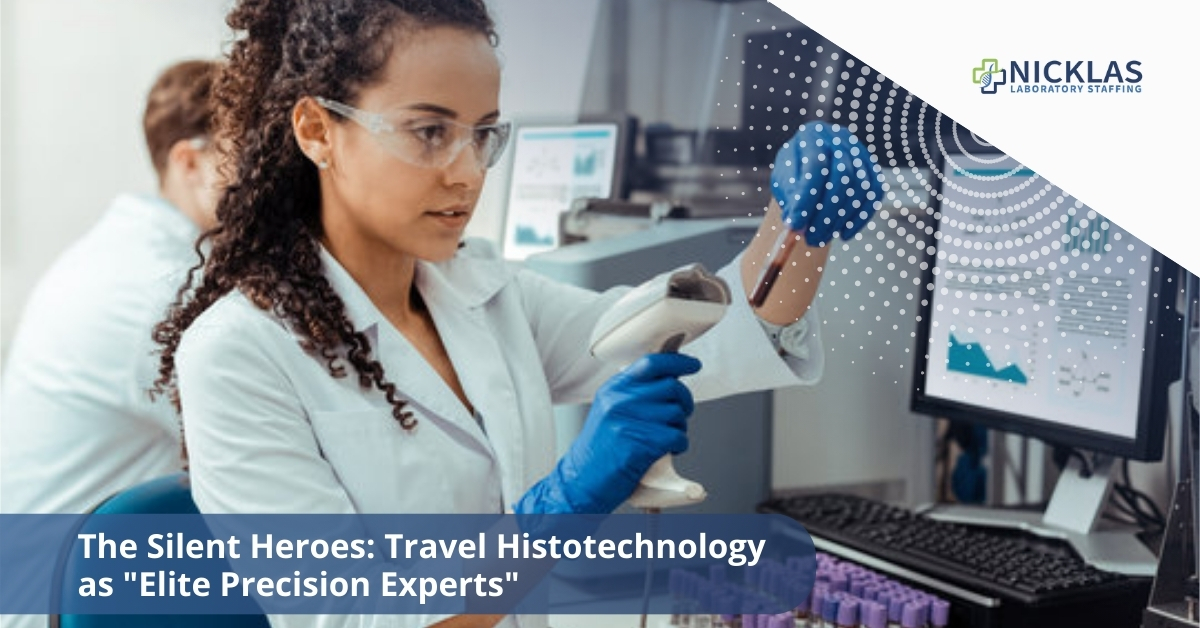
Without the mastery of these silent laboratory heroes, the diagnostic chain, stretching from the gross room to the final sign-out, would be broken. They are the Elite Precision Experts who transform raw tissue into the microscopic “maps” used to diagnose cancer, manage complex diseases, and inform surgical decisions. At Nicklas Laboratory Staffing, we view these professionals as the foundation upon which every accurate diagnosis is built.
The Precision Mandate in High-Stakes Diagnosis
In 2026, histology is no longer defined solely by the manual artistry of cutting and staining; it is a discipline centered on high-stakes data integrity. A single lost tissue fragment, a poorly oriented block, or a slide with technical artifacts, like “chatter” or air bubbles, can result in a lost or delayed diagnosis for a patient.
As laboratories integrate Digital Pathology and AI-assisted screening, the Scientist in Histology has become the crucial “human-in-the-loop”. Digital scanners require slides of impeccable quality, consistent thickness, and perfect staining to function. A suboptimal slide that a human might “read through” can cause an AI algorithm to fail or provide a false reading. Today’s histology professional must be as proficient with IHC automated platforms and molecular pre-analytics as they are with the manual artistry of a microtome.
Strategic Coverage: Protecting the Laboratory Workflow
While every histology professional is essential, the Travel Scientist in Histology represents an elite tier of the profession. At Nicklas, we provide comprehensive coverage for the gross room, histology lab, and cytology.
A permanent staff member often has months or years to acclimate to a specific Laboratory Information System (LIS), a particular brand of stainer, or the unique preferences of a pathology group. A Nicklas Laboratory Staffing travel professional does not have that luxury. They are trained to walk into new, often high-stress environments, master local nuances, and produce “gold-standard” slides within hours of their first shift. They are elite responders who bring stability to labs facing sudden volume spikes, equipment transitions, or leadership vacancies.
A permanent staff member often has months or years to acclimate to a specific Laboratory Information System (LIS) or the preferences of a pathology group. A Nicklas travel professional does not have that luxury. They are trained to walk into a new, often high-stress environment, master the local nuances, and produce “gold-standard” slides within hours of their first shift. They are elite responders who bring stability to labs facing sudden volume spikes, equipment transitions, or leadership vacancies.
Adaptive Excellence: Mastering New Environments
The true hallmark of a Traveling Histotechnology Professional is adaptive excellence. Whether navigating a legacy LIS or implementing a new digital pathology workflow, our travelers arrive with the cross-training and technical depth required to optimize the bench immediately. They don’t just “fill a gap” –they improve the workflow from day one.
Supporting the “Technical Trifecta”: PA, Cytologist, and Scientist in Histology
The most efficient Anatomic Pathology departments in 2026 operate on a principle we call the Technical Trifecta. This is the seamless, high-speed synergy between three distinct professional roles:
- The Pathologists’ Assistant (PA): Responsible for the critical initial macro-analysis and dissection.
- The Cytologist: Providing specialized screening and assessment for cellular-level diagnostics.
- The Scientist in Histology: Creating the foundational slide that enables the entire microscopic review.
When the histology bench is unstable, the entire trifecta fails. Backlogs in histology lead to delays in Cytologist screening and create a bottleneck that prevents PAs from maintaining their grossing pace. By securing elite histology support, you aren’t just filling a vacancy; you safeguard the flow of the entire AP department without friction. A stable histology bench protects the pathologist’s time, allowing them to focus on high-complexity sign-outs without the distraction of suboptimal slides or delayed turnaround times (TAT).
Workflow Audit: Identifying Bench Vulnerabilities
5 Signs Your Histology Bench is Reaching a Breaking Point:
- Rising TAT for Routine H&E: Are ”simple” cases taking more than 24 hours to reach the pathologist’s desk?
- Increased Request for “Recuts” or “Deeps”: Is the pathologist frequently citing suboptimal orientation, folds, or thickness?
- Digital Pathology Rejection Rates: Are your digital scanners rejecting more than 2% of slides due to technical artifacts that AI cannot interpret?
- Staff Burnout and Overtime: Is your current team consistently working 10+ hours of overtime per week just to maintain basic throughput?
- Diagnostic Risks: If your lab is experiencing two or more of these signs, your diagnostic chain is at risk.
Conclusion: A “Thank You” to the Laboratory Community
To the Scientists in Histology who work behind the scenes to provide the clarity that saves lives: we see you, and we thank you. Your work is the foundation of modern clinical medicine. As we celebrate Histotechnology Professionals Day 2026, Nicklas Laboratory Staffing encourages labs across the country to recognize their ”silent heroes“.
As we approach the high-stress summer transitions, now is the time to fortify your bench. Contact Nicklas Laboratory Staffing today to secure your Elite Precision Experts, sustain a seamless workflow, and uphold your patients as the priority.